Reactor Tank Lifting and Installation at Palm Paper, King’s Lynn
Cadman Cranes has supported the installation of a new wastewater recycling plant at Palm Paper’s King’s Lynn mill, lifting three 27-metre reactor tanks and two gas standpipes into position.
Working for Oostwouder NL, we managed the lifting operations from the arrival of the components at Boal Quay through to their installation at the mill. Further work for Econvert has included lifting access structures, internal equipment and components for a supporting gas-treatment plant.
The programme required approximately seven months of planning and coordination between the vessel, specialist transport, multiple crane providers and contractors working at the mill.
Project at a glance
| Client | Oostwouder NL and Econvert |
| Locations | Boal Quay and Palm Paper, King’s Lynn |
| Scope | Vessel offloading, tank installation and follow-on equipment lifts |
| Reactor tanks | Three tanks, each 27m high, 7.5m in diameter and weighing 33 tonnes |
| Gas standpipes | Two standpipes, each 26m high, 4m in diameter and weighing 4.5 tonnes |
| Cranes | Two 230-tonne cranes at the quay; 230-tonne and 350-tonne cranes at the mill |
| Programme | 2 days, September 2026, following approximately seven months of planning |
Supporting a Major Investment at the Mill
Palm is converting its King’s Lynn mill from newsprint production to corrugated case material, the paper used to manufacture corrugated packaging.
The family-owned manufacturer is working with Voith to adapt its PM 7 paper machine in response to declining demand for newsprint. Scheduled for the first quarter of 2027, the conversion will enable the mill to produce up to 700,000 tonnes of packaging paper each year using recycled paper as its raw material.
A new wastewater recycling plant forms part of this wider investment. It will treat water used during manufacturing so that it can be returned to the production process for reuse. Settlers positioned inside the three reactor tanks form part of the treatment system.
Cadman Cranes was initially appointed by Oostwouder NL to support the delivery and installation of the main tanks and standpipes. The scale of the components meant that the lifting operation had to be planned across two locations, beginning at Boal Quay and continuing at the mill.
Unloading at Boal Quay
The lifting programme began at Boal Quay on 5 September 2026, when the three reactor tanks and two gas standpipes arrived by vessel.
Our 230-tonne Liebherr crane worked in tandem with a second 230-tonne crane supplied by Emersons.
Both cranes operated with 72 tonnes of counterweight. Working together, they completed five lifts to transfer the components safely from the vessel onto specialist transport supplied by Collett’s and arranged by Oostwouder.
The tanks were transported horizontally because of their size. Once each component had been secured for the onward journey, our team moved from the quay to Palm Paper to prepare for installation the following day.
This sequence required close coordination between the lifting teams, vessel operations, transport provider and site personnel. The timing of each stage had to align with the delivery schedule and the readiness of the installation area at the mill.


Bringing the Reactor Tanks Upright
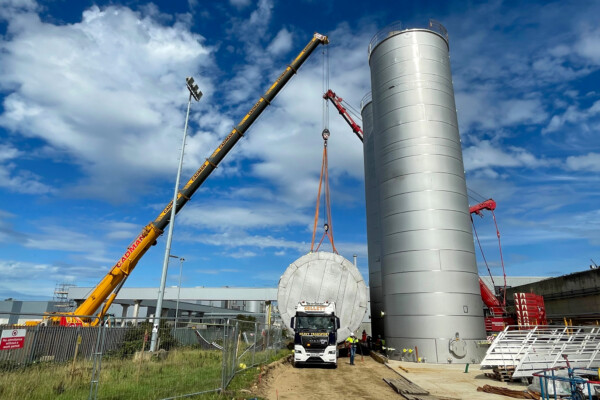
At Palm Paper, the principal lifting challenge was transferring each 27-metre, 33-tonne reactor tank from its horizontal transport position into a vertical orientation before placing it onto its prepared base.
The operation required a carefully controlled top-and-tail lift. Two cranes supported each tank as it was raised, with the distribution of weight changing continuously as the vessel moved from horizontal to vertical.
Planning began in February, approximately seven months before the lift. This included developing the lifting sequence and calculating how the load would be shared between the cranes throughout the manoeuvre.
Our 230-tonne Liebherr operated with 72 tonnes of counterweight alongside Bronzeshield’s 350-tonne Liebherr. The larger crane was configured with 140 tonnes of counterweight and Superlift to provide the required capacity and control.
As the main crane raised the top of each tank, the tailing crane controlled the lower section until the tank reached the vertical position. The load could then be transferred fully to the main crane for final placement.
Close supervision and communication between the crane teams supported each stage. Five lifts installed the three reactor tanks and two gas standpipes, completing the main lifting programme over two days in September.


Follow-on Installation Work
With the principal structures in place, our involvement continued through a separate programme of lifting work for Econvert.
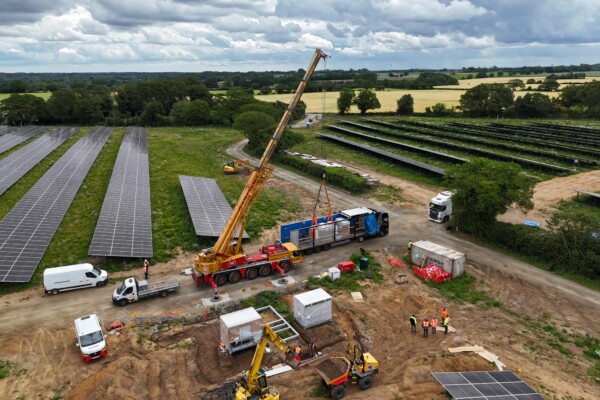
Cranes in the 60 to 90-tonne range were used to install access ladders and spiral staircases around the outside of the reactors. Further lifts positioned the settlers, pipework and supporting steelwork inside the tanks.
We also completed the lifting operations required for the associated desulphurisation plant. This system removes hydrogen sulphide from the biogas produced during treatment, preparing the gas for use as fuel. Its biological process allows the cleaning liquid to be reused, reducing the requirement for fresh chemicals.
The follow-on work involved regular coordination with other contractors as the wider installation developed. Our team planned daily lifting activities around site access, equipment readiness and simultaneous work packages to maintain safe operations and support the project programme.

Frank Lohmeijer, Project Manager, Oostwouder
“We were very happy working with Cadman Cranes throughout the project. From our first contact through to completion, everything went very smoothly. I particularly appreciated the personal effort and the flexibility of the company and its crews. It was a pleasure working with the whole team.”
The wastewater plant will allow Palm to recover and reuse process water, while the gas-treatment system will prepare biogas for use as fuel. Together, these systems support the mill’s transition to recycled packaging paper and its more efficient use of water and energy.
Our role has been to provide the lifting expertise needed at each stage, from unloading the main vessels and managing their installation to positioning the access structures and process equipment around and inside them.

Planning an industrial installation? Contact Cadman Cranes to discuss your lifting requirements.